Why IMAX Still Matters
I travel to London almost every month since my wife is working there, and one of my personal rituals is heading to the BFI IMAX. This cinema, run by the British Film Institute, has become my go-to spot. The screen itself is enormous (about 26.5m x 20.4m, roughly 540 m², making it one of the largest in Europe). And the projection quality? Always reliable. Considering how many multiplexes now run mostly on autopilot, having a team that actually checks focus, sound levels, and presentation feels like a luxury.
Of course, it is not cheap. Even with my BFI membership, tickets are around £25. But sitting on those stadium like seats in front of one of the biggest IMAX screens in Europe with a pristine surround sound is, without doubt, an immersive experience.
Studios have noticed this too. IMAX is not just for superheroes or explosions anymore. Dramas, comedies, even smaller films are being formatted for IMAX. The reason is simple: IMAX tickets are more expensive, so studios push for that "filmed for IMAX" stamp to boost revenue.

What makes IMAX different?
[You can expand or cut this section as needed.]
Just a quick background of the format. IMAX was born in Canada in 1967, when a group of experimental filmmakers designed a projector that ran 70mm film horizontally instead of vertically. That change allowed much bigger image frames compared to traditional 35mm film.
Today, IMAX screens use advanced dual-laser digital projection, capable of resolutions equivalent to up to 18K on giant curved screens as tall as 30 meters. Add to that a custom-tuned sound system for every auditorium, and the result is that "you are inside the movie" effect. As IMAX itself puts it: "Every IMAX theatre in the world is designed, built, and maintained with meticulous care and standards. Our theatres are calibrated daily to ensure you get the best possible experience." (IMAX)
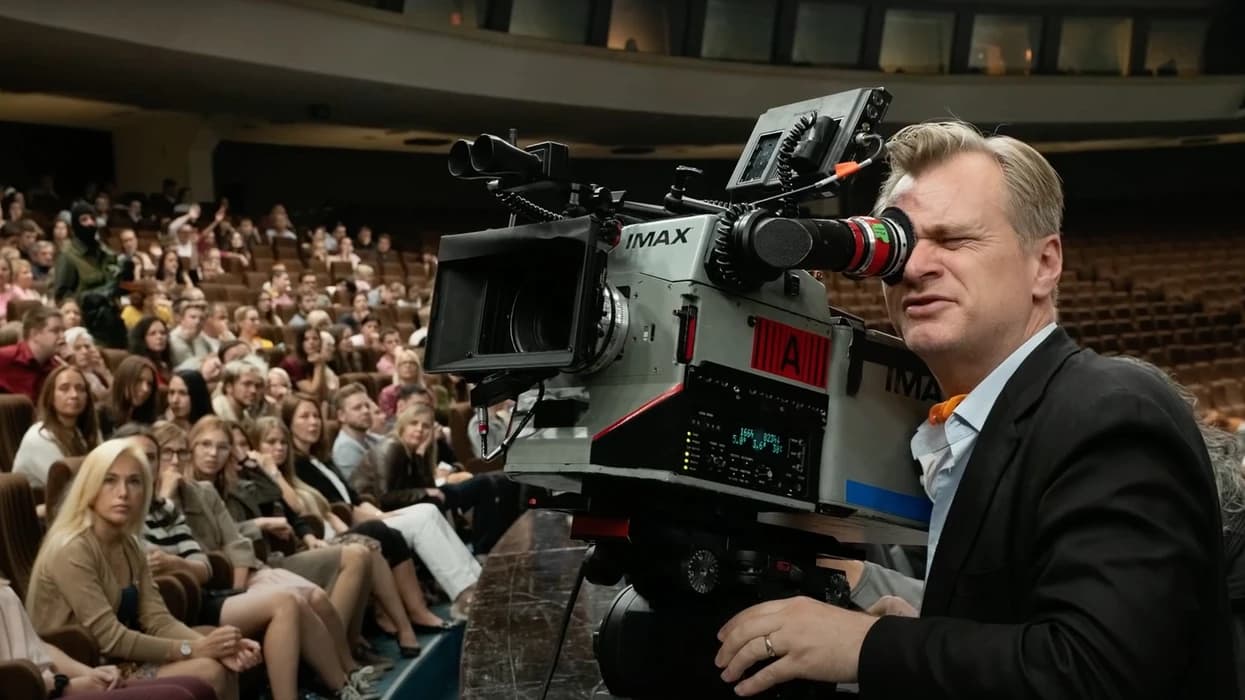
Some directors swear by it. Christopher Nolan (Dunkirk, Oppenheimer) and Denis Villeneuve (Dune: Part Two) shoot entire sequences with IMAX film cameras. The cameras are famously bulky and noisy, but the result is an image so sharp it feels almost unreal. Technology is definitely moving toward quieter and lighter cameras, and reports suggest that in 2026 we may be rewarded with the first fiction feature filmed entirely in IMAX, Christopher Nolan's Odyssey (Variety).
Paris, my perfect city (with one flaw)
I love Paris, and I really think it is one of the most perfect cities in the world. But one thing it lacks is a truly central, giant IMAX like the BFI. There are a couple of IMAX venues on the outskirts, such as Pathé La Villette, but they are harder to reach and often show dubbed versions. There was also La Géode, a spectacular dome theatre at Parc de la Villette, which for decades showed IMAX-format documentaries on its hemispherical screen of around 1,000 m². However, La Géode has been closed since 2018 and is not currently showing films. So for most moviegoers in Paris, there is no equivalent to the scale and reliability of London’s BFI IMAX, and that still feels like a missed opportunity.
Old films, new life
One of the things I adore about the BFI IMAX is that they also screen classics. Last weekend, I caught 2001: A Space Odyssey (1968) in 70mm there. It was not made for IMAX, but it still looked incredible on the massive screen.
Even more fun: watching Top Gun (1986) again. The beach volleyball scene with jeans? Still as weird as ever, but somehow even more hypnotic and gorgeous blown up on that giant IMAX canvas. Don't get me started on the sunset on a air carrier.
Why I send my students
Whenever there is a big release, I strongly encourage my students to go see it in IMAX. I tell them it should be a social event, go with friends, make a night out of it.
Many of them already have 80-inch 4K TVs at home, so I get it: paying for a cinema ticket feels like a waste when the movie will stream in a month. But IMAX still guarantees something streaming does not: scale, quality, and the collective energy of watching a story unfold with a crowd.
I have had screenings ruined before, out-of-focus projectors, or in Shanghai, when they stopped a film mid-credits because I was the only one in the theater. That never happens with IMAX. The name itself is a seal of approval. When I buy a ticket, I know I will get the film the way the filmmakers intended.