I have just returned home from an incredible experience. I watched Christopher Nolan’s The Odyssey in a cinema that opened only three days ago, inside what will surely become my second home. I am still trying to process the immensity of what I saw.
For the first time in years, perhaps since Avengers: Endgame (2019), I struggled to find a ticket. Every IMAX screening I checked in Paris seemed to be sold out. The Dolby Cinema screenings were full. Even many standard screenings had very few seats available.
We probably managed to get tickets only because this new cinema has barely announced that it is open. Even then, the room was full, and we ended up sitting in the first row.
Normally, those words would describe a small cinematic tragedy, or at least a recipe for neck pain. Here, however, the design of the theatre made the first row feel surprisingly comfortable. Instead of looking up at the screen, I felt pulled into it. The sea seemed to extend beyond the frame. The landscapes surrounded us. The scale became physical.
Let us be honest. Shakespeare, Beowulf and The Odyssey are not titles that automatically suggest mass entertainment to a modern audience. Yet I had just left a packed cinema after watching a 172-minute adaptation of a text composed almost 2,800 years ago, and my chin was practically on the floor. Christopher Nolan’s answer to how this is possible is simple: cinema.
The film has a stellar ensemble led by Matt Damon as Odysseus, with Tom Holland, Anne Hathaway, Robert Pattinson, Zendaya, (my muse) Charlize Theron, and Lupita Nyong’o among its extraordinary cast. Damon remains the centre of gravity, but the other characters never feel like decorations surrounding the hero. Their stories, relationships and absences carry real weight.
This matters because The Odyssey does not feel like a conventional star vehicle. It feels like a genuine epic, one in which every departure, reunion, delay and decision contributes to the emotional scale of the journey.

The structure is particularly impressive. Nolan has often been described as a filmmaker obsessed with nonlinear storytelling, but here he is not simply imposing one of his usual devices on an ancient text. Homer’s poem already contains stories within stories, memories within memories and extended flashbacks.
Nolan has described the original structure as remarkably radical. His adaptation recognises that The Odyssey was playing with time thousands of years before Memento (2000), Inception (2010) or Oppenheimer (2023).
I will not go deeply into the plot because there are too many layers, images and discoveries that deserve to be experienced without explanation. I will only say that the intensity never disappeared for me. Despite its length, the film kept expanding rather than slowing down. Every new location seemed to open another door into its world.
Nolan’s commitment to physical filmmaking becomes essential to this experience. The Odyssey is the first feature film shot entirely with IMAX film cameras, meaning that every frame was captured in the format.
I wrote some time ago that IMAX is “plus cinema.” It does not simply give us a larger screen. It adds another physical dimension to the relationship between the audience and the image.
Even when viewed in a high-resolution, non-IMAX theatre, the original image carries an extraordinary level of depth and detail. The perils of the sea do not appear to be digital backgrounds placed behind the actors. The water has weight, movement and danger. The landscapes do not simply establish where the characters are. They help us understand the scale of what those characters must cross.
Nolan understands something that very few directors understand at this level: the size of an image can become part of its meaning. He does not use IMAX simply because it is bigger. He uses it because scale changes our relationship with what we see.
A person surrounded by an immense landscape becomes vulnerable. A ship placed against the horizon becomes fragile. A face filmed with that level of clarity becomes almost impossible to hide behind.
Nolan has said that IMAX can make the screen seem to disappear, filling the audience’s peripheral vision and creating something close to three-dimensional immersion without glasses. Watching The Odyssey, I understood exactly what he meant because the image did not seem contained by the edges of the screen.
The technological achievement behind the film is almost as fascinating as the film itself. Traditional IMAX cameras are extremely loud, which previously made them difficult to use during intimate dialogue scenes. For this production, IMAX developed a noise-reducing enclosure called “the blimp,” allowing Nolan to record synchronised dialogue while continuing to use the cameras.
The complete camera system could weigh approximately 136 kilograms. The film magazines also held only around two and a half to three minutes of footage before they needed to be reloaded.
From an actor’s perspective, this must create extraordinary pressure. The camera begins turning, and everyone knows that the film is physically running out. There is no possibility of recording an endless series of takes while people gradually discover the scene. Every department must be prepared. Every actor must be present. Every minute costs film, time and money.
Lupita Nyong’o has described how this limitation created a distinctive concentration on Nolan’s set. Everyone had to remain ready and alert. The machinery imposed discipline, and that discipline seems to have found its way into the performances.
The scale of the production makes its efficiency even more surprising. The shoot had been scheduled for 100 days but finished after 91. The production travelled across Greece, Italy, Morocco, Iceland, Scotland and the United States, while using real locations, full-scale constructions, thousands of costumes and more than two million feet of IMAX film.
Its reported production budget was $250 million. That is an enormous sum of money, of course, but the money is visible and, from what appears on screen, incredibly well invested.
It is visible in the locations, the costumes, the physical environments, the ships, the crowds and the sheer confidence of the production. Nolan has not spent this money merely to make the film look expensive. He has spent it to create a world that feels tangible, which makes an enormous difference.
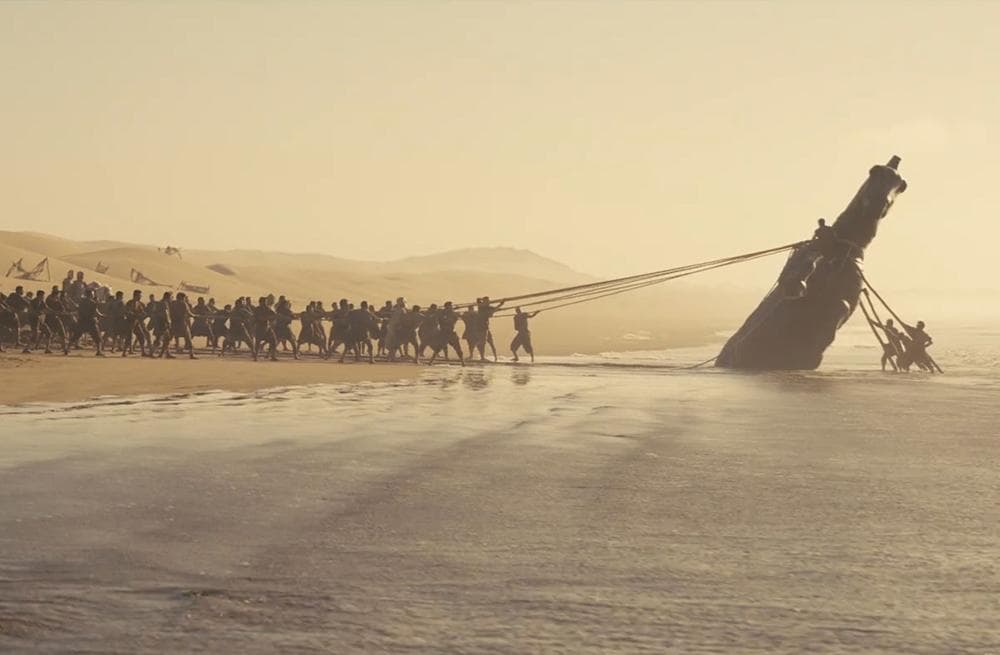
Many contemporary blockbusters show us enormous things without giving us any sense of their actual size. The Odyssey repeatedly makes scale understandable by placing human bodies within it. We see the effort of movement. We feel distance. The establishing shots of Ithaca make us understand how small individuals are within this world. We also understand their exposure to the elements.
The film does not simply tell us that the journey is difficult. Its visual language makes that difficulty physical.
In the Daily Show interview that I watched before the film, Nolan explained that a film is not truly complete until it reaches its audience. He said, “The audience finishes the movie,” and this idea remained with me throughout the screening and after I returned home.
Films do not end when the editor exports the final cut. They do not end when the sound mix is approved or when the studio begins its marketing campaign. They become complete when people gather in a dark room and experience them together. By the end of The Odyssey, I was in tears.
I live in Paris, where audiences can sometimes maintain a carefully cultivated air of indifference. Enthusiasm must occasionally pass through several layers of intellectual suspicion before it is allowed into the room. Yet when The Odyssey ended, people applauded in my cinema, even though this was not a premiere, festival screening or special event.
They did not applaud because somebody had told them that the film was important. They applauded because they had been through something together.
For almost three hours, a room filled with strangers shared the same silences, tension, astonishment and emotional release. No one paused the film. No one checked what was happening on Snapchat or Instagram. No one reduced the image to a small rectangle while answering a message. We surrendered our attention to Nolan’s art.
Let us be honest: streaming cannot reproduce this experience.
Streaming can give us access, convenience and an extraordinary library of cinema, but it cannot completely recreate the feeling of entering a room with strangers and allowing a film to control the dimensions of our world for several hours.
I am particularly curious to see how my young adult students will respond to The Odyssey. Many of them have probably never read Homer’s poem. Some may hear the words “ancient Greek epic” and imagine an obligation rather than an adventure.
I sincerely hope they go because I want them to see that a foundational text does not have to remain trapped inside a classroom or behind the glass of cultural respectability. A story can survive for almost three thousand years because each generation finds a new way to tell it.
Nolan has not made Homer smaller so that a modern audience can understand him. He has used the full power of contemporary cinema to show why this story became immortal. This is Nolan’s particular magic, and it may be the film’s most remarkable achievement.
Christopher Nolan has taken an ancient poem, a reported $250 million budget, an enormous international cast, experimental IMAX technology and some of the most demanding locations imaginable, and turned them into a collective theatrical experience that audiences genuinely want to attend.
The marketing campaign certainly helped. Tickets for selected IMAX screenings went on sale in July 2025, an entire year before the film’s release. The reputation of Oppenheimer helped. Nolan’s name helped.
However, marketing can sell the first ticket, but it cannot manufacture the silence of a captivated audience or the applause at the end. Only the film can achieve that.
I already plan to watch it again on Monday, this time in IMAX. I am fortunate enough to have a new IMAX screen only ten minutes from my home, and I cannot wait to enter this world again with an image large enough to overwhelm my peripheral vision.
So, thank you, Mr Nolan, for continuing to believe that cinema should be experienced collectively and for treating the theatre not as a delivery system, but as part of the artistic form.
Thank you for reminding studios that audiences will still leave their homes for something ambitious, demanding and visually extraordinary.
Most personally, thank you for giving me, a humble high school film teacher, another tool with which to convince a younger generation that cinema is art and that watching it together remains one of our most powerful social experiences.
The collective experience of cinema remains magical, and we cannot let it die.